Outstanding in the Field

A table for 120, set at North Arm Farm in Pemberton, BC. More pictures here. Right: full moon over Okanagan vineyards, Meyer Vineyards.

Monday, June 20, 2011

Finding Bliss on No. 5 Road


The main Shrine Hall at Thrangu Monastery in Richmond, British Columbia

RICHMOND, BC--We're here at the height of hockey fever, and the Canucks failed to bring home the trophy. But it's okay. Really. A word of explanation:

In medieval Burgundy, the Cistercian monks--who knew how to read, so they understood the value of writing things down--came up with notion of identifying specific plots of grape vines, the beginnings of the modern system of appellations. And to this day, they make some of the best cheese in France, Cîteaux. We have come to expect that tireless devotion and unquestioning obediance (on the part of others) lead to something delicious (for us).

Monk.JPGBhuddist monks, on the other hand, are under no obligation to "produce" anything. Their monasteries serve as a refuge for study, prayer and meditation (called, simply, "practice") undisturbed by worldly concerns. "In this way, monasteries serve as a means to accumulate wisdom," says 25-year-old Lama Rabjor Daw, the Thrangu Monastery's emissary to the outside world, and the only monk with a cellphone.

Thrangu is the first traditional Tibetan monastery in the northwest of North America. It was founded last year by the Very Venerable Thrangu Rinpoche ("Precious One"), who, in addition to his role as a spiritual leader, is also among the foremost scholars of Buddhism. When he visits the monastery, he doesn't deliver sermons; he comments on and interprets holy texts.

A young Tibetan monk named Karma Dradu, 32 years old at the time, designed and executed all the decoration. The centerpiece of the sanctuary is a 16-foot, gold-plated statue of the Shakyamuni Buddha, flanked by 35 Buddhas of Confession and 500 Medicine Buddha statues.

The rationale for a monastery in British Columbia, according to the website: "to help spread the genuine Dharma in many lands, thus quelling the misfortunes of epidemics, famine and war in this world and helping peace, education, and prosperity to flourish." Sounds like the thrills of winning the Stanley Cup will have to wait here, as well.

Lama Rabjor, the one with the cell phone and keys, says it's important to welcome tourists, to show the public what Buddhism is all about. He betrays none of the impatience or defensiveness one might expect of a young man in his 20s. No less important, of course, is to serve the tens of thousands of Buddhists who now live in the Vancouver area.

The monastery's resident monks and the occasional visitor live in simple rooms (indoor plumbing, but no TV). So there wouldn't be any temptation to watch to hockey. The monks are vegetarians, of course; the pleasrue of food is not part of their lives. That barbecue in the courtyard? It's for a ceremonial fire, nothing more.

Thrangu Monastery, 8140 No. 5 Road, Richmond BC

Our visit to Richmond was sponsored by Tourism Richmond.

From drip to sip in just 18 hours

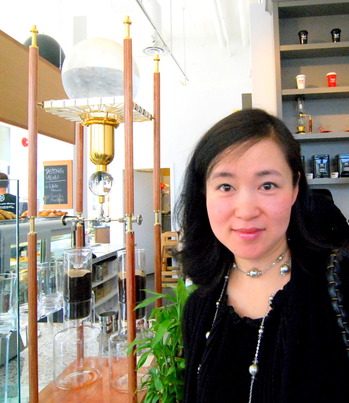
RICHMOND, BC--Dawn Peng's new coffee shop in Steveston Village is called Rocanini, which sounds Italian (it's not) but is meant to convey a sense of strength and European style. Her baristas don't "pull shots," they grind the beans to order (single-origin, of course) and brew each cup individually using a Japanese Bonmac cold-water syphon. If this all sounds a bt much, you can also get a simple drip-filter coffee, but be warned: this showcase is what the future looks like. Peng and her partners are planning five to ten similar coffee shops in the Vancouver area within the next two years.

That giant gadget on the counter? The one that looks like a high-tech James Bond torture machine? Ice water goes into the big glass bowl at the top and drips slowly, slowly, slowly through the tubes, into a couple of cylinders filled with finely ground, single-origin coffee. One drop in, one drop out. (More technical details on the topic in this New York Times article.) This is for the latest craze, Japanese-style iced coffee, which obviously gets made ahead: from ice-water-in to coffee-concentrate-out, it's an 18-hour process. A creamy mouthfeel, it's said, dark, smooth and intense. So far, this is the only such device in Canada.

The resulting brew is also enjoying a surge of popularity in New York City, where the website Eater.com has even published an interactive map of Manhattan coffeeshops with especially good iced coffee. One of the best is the Gotham outpost of Portland's Stumptown. (Parenthetically, a New York private equity firm has recently taken a major ownership position but left founder Duane Sorenson in charge..for now.) No plans for a cold-brew system at either one of Stumptown's two Seattle stores, although they do sell "Stumptown Stubbies" of cold-brew coffee locally.

UPDATE 6/21: Seattle Coffee Works has one of these contraptions as well, has had for over a year. (Gulp.) James Ross Garner wrote about it in Seattle Metropolitan Magazine.

Rocanini Coffee Roasters, #115-3900 Moncton St, Steveston, BC, 604-284-5126  
Rocanini on Urbanspoon

Our excursion to British Columbia last month was sponsored by Tourism Richmond as part of a media preview of "Richmond's Ultimate Food Experience."

Saturday, June 4, 2011

Smoke that rib! Burn that end! Pull that pork!

STEVESTON, BC--This fishing village, home to the largest commercial salmon fleet in North America, they say, and part of a community of over 100,000 Asian immigrants, has also produced an anomaly: a barbecue joint called the Hog Shack.


Now, there is barbecue and there is barbecue, and the debates are theological in intensity. For some, barbecue means "falling off the bone." But, say the Protestants, that's braised meat, considered apostasy by those whose salvation lies in meat that is "dry-smoked."

Into this culinary minefield, last October, jumped Allan Yeo and John Lim Hing, business partners and owners of a local steakhouse, the Mandalay. Their inspiration, they claim, was Kansas City barbecue, although any reader of Calvin Trillin knows that's way too high a standard.

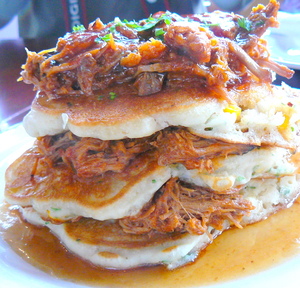
Their most interesting concept, to my palate, was a dish of pancakes layered with pulled pork and served with maplejack syrup and bacon butter. Perhaps that's because I fall into the agnostic camp of prefering moister barbecue? It's not on the menu; when the kitchen rustles up a batch, the owners put it out on Twitter (@hogshackca), then sit back and wait for the crowds. So far, they say, the strategy is working.

I was less taken with the dino bones (beef ribs, smoked for five or six hours) and the burnt ends (brisket trimmings, smoked for another six hours). Hog Shack's side dishes (coleslaw, baked beans, corn bread) didn't particularly impress me, either. There's no beer on tap, just a modest selection of bottled microbrews.

Hogshack's Facebook page features a Wall of Shame filled with pictures of glassy-eyed eaters who have attempted the five-minute Flat Liner challenge (a burger-eating contest). To my taste, all this is frat-boy fare, food for 20-somethings whose palates are still developing. Not that there's anything wrong with that; far from it.

It's a gorgeous weekend, and the Tall Ships are in the harbor. Harbour, sorry.

My visit to Steveston was hosted by Tourism Richmond.

Hog Shack Cook House, 3900 Bayview St., Steveston, BC 604-272-7264 Hog Shack Cook House on Urbanspoon

Friday, June 3, 2011

Spot that prawn! Cake that crab!

Spot prawn platter at Tapenade Bistro
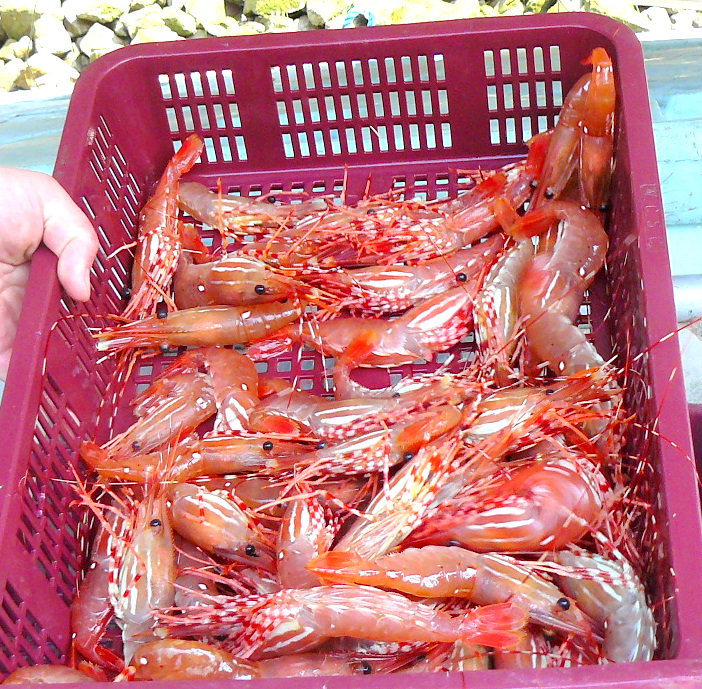
Steveston Village, BC--You can feel good eating spot prawns; the fishery is local and sustainable. Two thirds of the commercial BC harvest comes from the Inside Passage, between Vancouver Island and the Mainland in relatively shallow (200-foot) coastal waters; they're caught in baited, funnel-shaped traps dropped to the ocean bottom attached to longlines. Most of the catch is frozen at sea and exported to Japan, but ten percent or so is sold fresh locally. It's a short season, starting in mid-May, and lasting less than three months.

Spot prawns--the largest of seven commercial species of shrimp found off the west coast of Canada--lead a short, happy life. Immature in their first season, they become male for a couple of years, then turn female. It (or rather, she) can grow to a size of nine inches, but most are harvested at about a third that size. They're sweet and delicate, with fimrly-textured meat. Ocean Wise, the Vancouver Aquarium's list of sustainable seafood, gives the highly regulated catch a big thumbs up, as does the Monterey Bay Aquarium's Seafood Watch.

We had the good fortune to be dockside when the fishing boats arrived with their cargo of fresh, live prawns. Tossed into a simmering court-bouillon (onion, celery, carrot, bay leaf, thyme), or briefly steamed, they're ready in minutes. Twist off the head (and suck the juices out, if you're game), then split the back shell open with your fingers. Mayonnaise or aioli is barely necessary. Chef Alex Tung at Tapenade Bistro in Steveston serves a huge platter with two pounds of prawns, chorizo sausage and fingerling potatoes for $70; it would easily feed two hungry adults or a table of six as an appetizer.

To accompany the spot prawns, Tapenade served a lovely sauvignon-sémillon blend called Alibi from the dramatic Black Hills Winery on the Naramata Bench outside Oliver, in the Okanagan Valley. This is one of the best vineyard sites on either side of the border, and one worth seeking out.
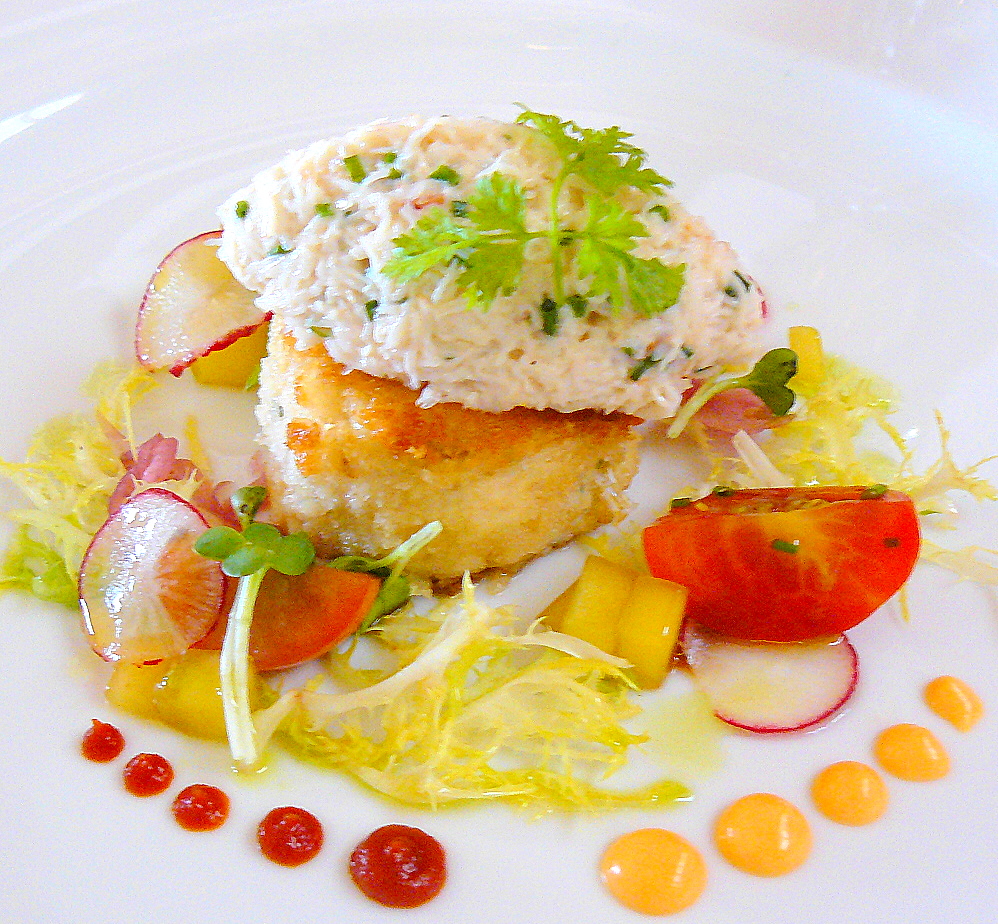
No less impressive than the prawns was the Dungeness crab cake ($14 for a pair), topped with a spoonful of remoulade. No surprise that Chef Tung was named best chef on the Lower Mainland by the Georgia Straight. No surprise at all.

By the way, the Tall Ships are just outside Tapenade's front door this weekend.

Tapenade Bistro, 3711 Bayview St., Steveston, BC, 604-275-5188  Tapenade Bistro on Urbanspoon

Monday, May 30, 2011

Urban Agriculture: More Fava Beans, Less "Angry Food"


Richmond, BC--Terra Nova is a 100-acre city park just across the Middle Arm of the Fraser River from the YVR airport. Most of the land is a wildlife and nature preserve, but a third of it is devoted to urban agriculture. (A farm surrounded by housing isn't unusual in Richmond, by the way; there are 250 farms inside the municipality. King County has a total of 50.)

Ian Lai, an environmental educator who also teaches professional students at the Northwest Culinary Academy in Vancouver, runs the farm school and related operations here with infectious enthusiasm and a sort of Swiss-Farmily-Robinson resourcefulness: the farm teaches grade schoolers about gardening and agriculture; each kid gets six square feet to grow fava beans, for example. There are p-patches for individuals ($40 a year to rent a 9-by-27 foot space), larger plots for community organizations and food banks, and an innovative program to involve restaurant cooks in the maintenance of the property. (The closest thing in Seattle is the much smaller cooperative farm called 21 Acres in Woodinville, currently building a Green Center for Local Food and Sustainable Living.)

Lai was once a chef himself, so he understands what a lot of people prefer not to talk about. Restaurant kitchens--not all of them, to be sure, but many, many--are staffed by overworked and underpaid cooks who don't really know (or particularly care) where food comes from, except "through the back door and out of a box." The result is what Lai calls "angry food."
So, to replace the ignorance and frustration he encountered with his professional students, Lai began teaching respect and appreciation for the land and its abundance.

Six years ago, he founded the Richmond Schoolyard Society, originally so his young daughter and her classmates could learn about food by growing food; the program has since taken off and now serves 500 children city-wide, and Richmond's most celebrated chefs have joined his board of directors. There are Mason Bees in the orchards, and flour to grind into wheat that gets baked in a handmade oven. Visitors harvest edible wild greens ("they're not weeds, just another form of money"). Lai recylces and resuses almost everything; he'll pickle surplus mustard greens and make wine from the dandelions. Even the meadow of ranunculus--bitter, mildly poisonous--has its purpose: they're a carpet of beautiful buttercups.


Note: My trip to Richmond and environs was sponsored by Tourism Richmond.

Saturday, May 28, 2011

Richmond's Vibrant, Tasty Night Market

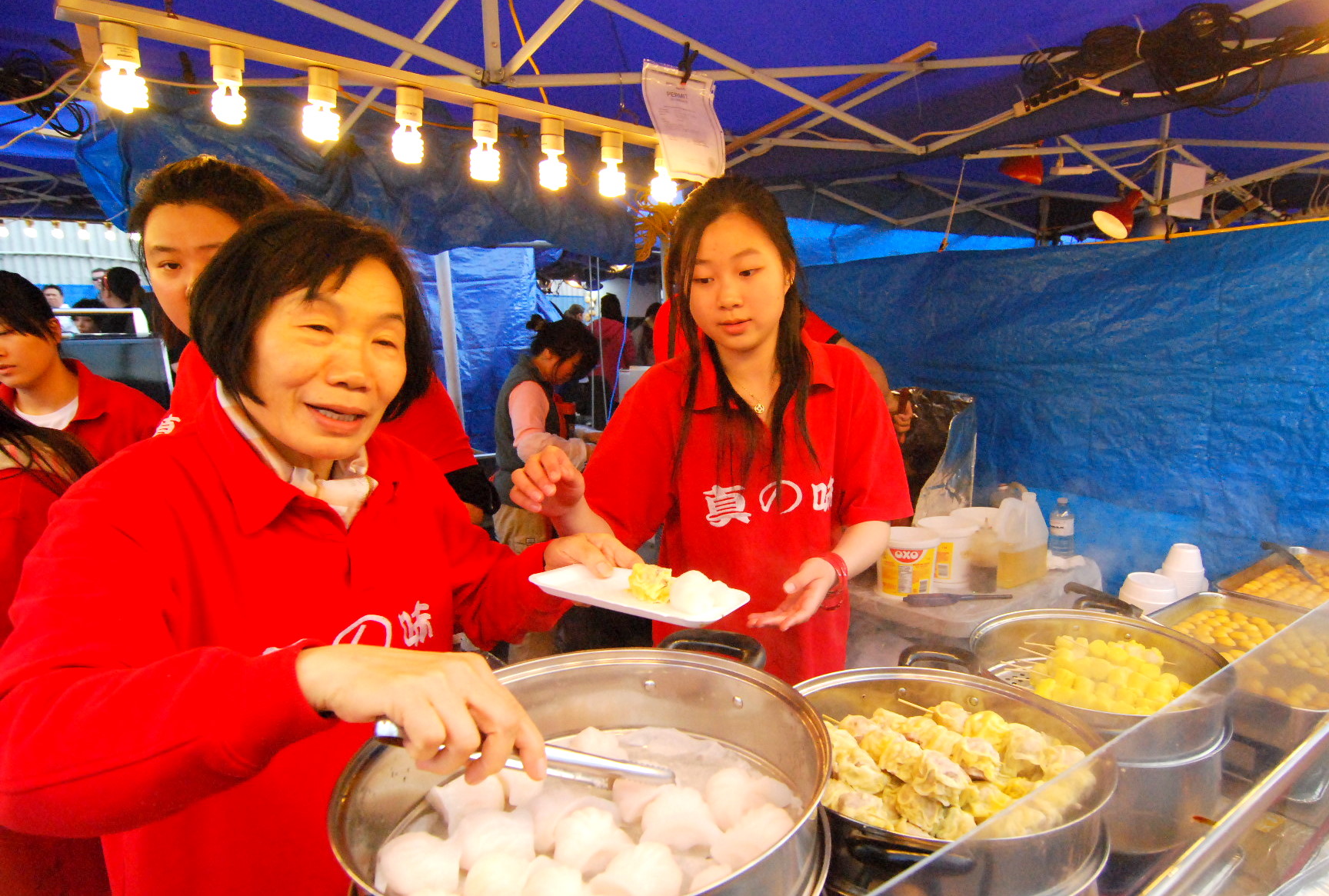
Top Wok Dim Sum's Mamma Mak and her helper Kimmie at the Night Market

Richmond, BC--This community of 200,000, just south of Vancouver, used to be familiar to travelers as the location of YVR airport. Today it's famous as the home of the largest immigrant community in Canada. Half the people who live here are foreign-born, two-thirds of them Asian. And they have brought with them a diversity of food cultures (Chinese, Japanese, Korean, Thai, Vietnamese, Filipino, Cambodian, Laotian, Malaysian, Indian, to name just the most obvious) unique to this continent. Noodles, stir-fries, satays, dumplings, teas, barbecues: they're all at Richmond's four-year-old Summer Night Market.

Modeled on Hong Kong's, it's the only Asian-style night market in North America. (I've been to night markets in Thailand, where they flourish as social centers, food courts and shopping malls.) Some 250 vendors set up shop three nights a week in a 125,000-square-foot parking lot between an import warehouse and the North Arm of the Fraser River, just off the Knight Street Bridge. Most of the stands sell "stuff"--cell phone accessories, Samurai swords, cheap jewelry. Its the others, 60 or more, that I've come to see, the ones selling food.

It's street food, of course, quickly prepared and eaten by hand while it's piping hot. Unique food like the dried, salted and roasted squid, at a stand operated by Eddy Lee and his dad Shum Lam Lee; the flattened filet (from Vietnam or Thailand) is grilled, then run through a tenderizing machine that looks like it could be rolling out linguini. There are deep-fried potatoes on a stick that have been spiral-sliced like a slinky, the edges dipped in powdered cheese and drizzled with a spicy ketchup. There are traditional spring rolls and dim sum and sautéed calamari. Tofu pudding, dragon beard candy (yum!), waffle cakes filled with Bavarian cream or red bean paste. William Liu's family has been selling dim sum and gyozas in Chinatown for decades; now his house-made, home-made, hand-made gyozas and shrimp-paste-stuffed eggplant are at the night market as well. Nick and Lin Fan shake up two dozen flavors of bubble tea. Nash Chenpratum grills Thai chicken satay with peanut sauce. Chef James Chen grills beef for barbecued skewers; he wears a microphone and calls out invitations to passersby. The Mak clan from Top Wok dim sum are out in force, Mamma, Joe and Leo, with so many products they have booths on opposite sides of the main aisle. There's even a token Italian vendor doing a brisk business in pasta, meatballs and tiramisù.

The crowd is relaxed, young for the most part, with plenty of backpacks and the occasional stroller. No alcohol is served at the market, no beer garden, no nearby taverns or bars. The only music comes from a performing arts stage between the food stalls and the ranks of tee shirt vendors, where a local teen group called Collabocal performs hip-hop and breakdance routines. It's a very organized, very sober, yet very vibrant version of Bite of Seattle, with more varied food and a much.longer schedule: 17 weekends instead of, gulp, just one.

Here's a stop-motion video of the action--tens of thousands of visitors every night--on YouTube.
This was just the first night of this food tour weekend. I'm here as the guest of Tourism Richmond, and look forward to tasting much, much more in the next couple of days.